The figure below illustrates a scalable quantum network organized using a three-plane abstraction. The infrastructure plane at the bottom represents all physical devices and fiber connections. The logical plane in the middle captures the repeater-chain abstraction once a network orchestrator has identified a suitable path between end nodes (e.g., A and B in dark green). The control and service plane at the top encompasses orchestration, routing, and user-facing services accessed through standard interfaces. We adopt this layered abstraction to structure our work on network architecture and protocols, enabling systematic study of scalability across distance, node and user counts, heterogeneity, and entanglement distribution rates, and providing a framework for integrating device models from Thrust 1 and error management methods from Thrust 2 into protocol-level evaluations.
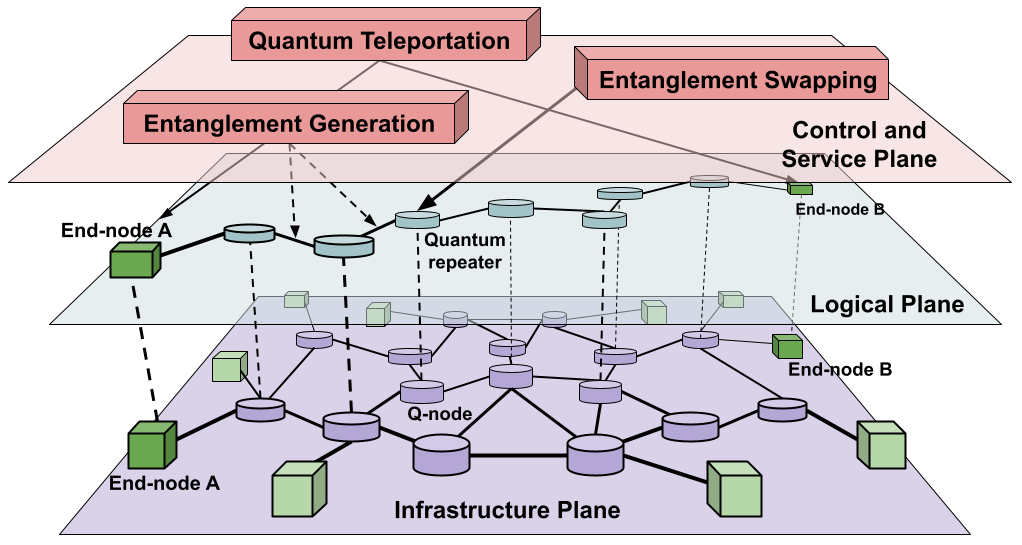
The three-plane abstraction provides a unifying framework for reasoning about quantum network architectures. The infrastructure plane captures heterogeneous devices and links, the logical plane describes the generation, purification, and verification of entanglement, and the control/service plane coordinates these resources to support user applications. Our architectural analysis highlights that scalability depends not only on distance but also on node and user counts, heterogeneity, and entanglement distribution rates.